Keeper vs 1Password:
¿Cuál es mejor?

Explora la comparación definitiva entre Keeper y 1Password. Descubre qué gestor de contraseñas gana en seguridad, características y usabilidad. Obtenga la información que necesita para elegir la protección adecuada para su personal, sus dispositivos y sus datos.

A partir de solo
 
 
por usuario/mes *zzgl MwSt *Includes GST
Para uso personal

¡Extra! Incluye un Plan Family Gratis para cada miembro del equipo.
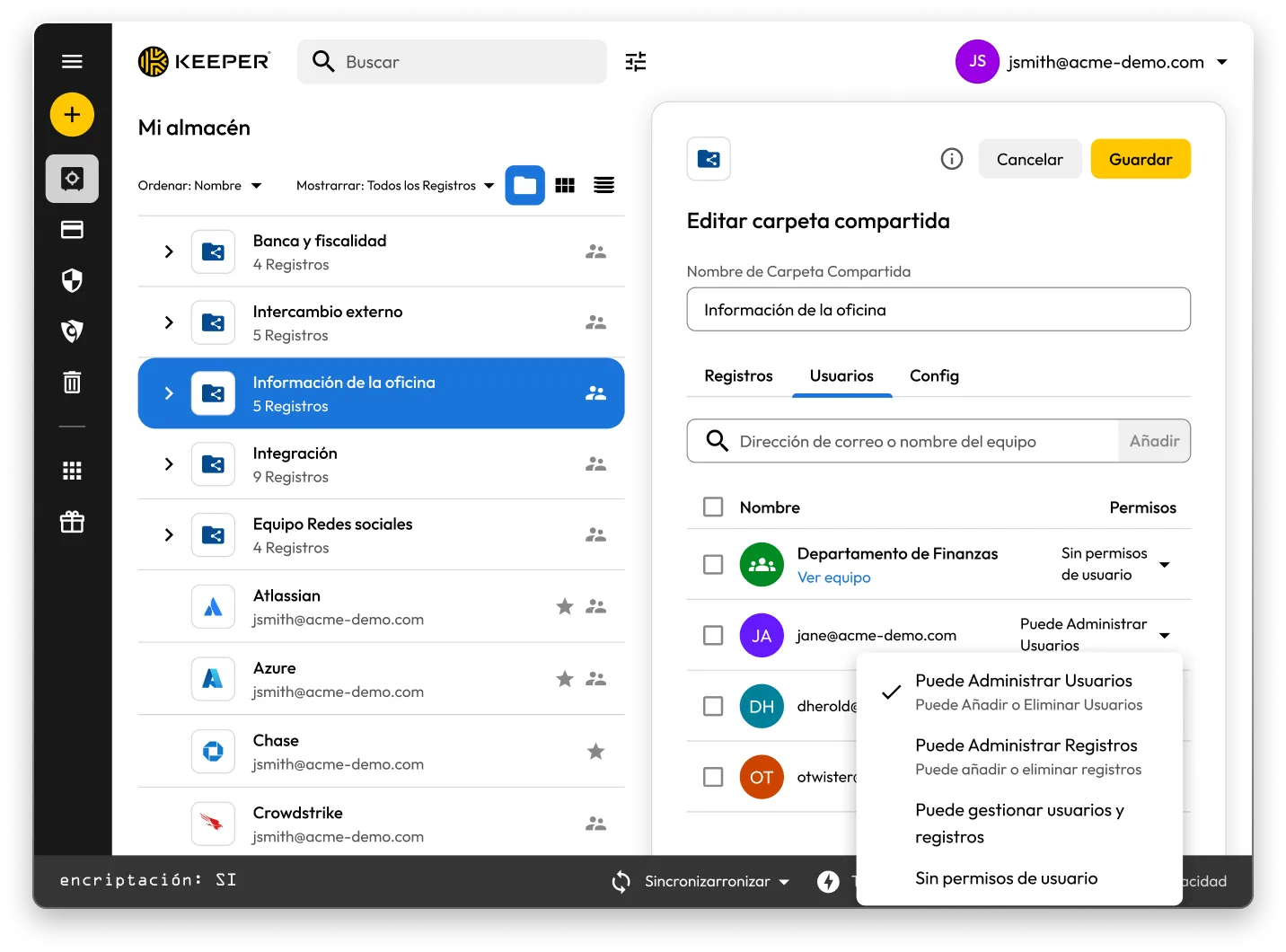
La interfaz de Keeper Vault que muestra carpetas y registros compartidos. El panel

Keeper vs 1Password: Side-by-side comparison

Keeper
1Password
Security architecture and encryption model

Keeper's zero-knowledge architecture encrypts every individual record and folder with its own unique AES-256 key, with all encryption and decryption performed locally on the user's device. Keeper's "Transmission Security" adds a second layer – TLS 1.3/1.2 plus an additional 256-bit AES transmission key – covering all data communications, not just authentication. HSM integration in AWS provides super-encryption at rest.

Keeper Forcefield technology protects against memory-based attacks that specifically target password managers.

Keeper's self-managed BreachWatch® dark web monitoring runs entirely within its own infrastructure using an HSM-protected architecture, so breached passwords are never correlated against vault data outside Keeper's systems.

Keeper holds 10 issued U.S. patents covering its zero-knowledge architecture, SSO, breach detection and secure messaging, with four more pending.

Based on publicly available documentation, 1Password uses a vault-key-based encryption model: individual items are encrypted using keys derived from that vault key, rather than each having an independently generated key. Its SRP protocol handles authentication; data in transit is protected by TLS, though this operates separately from 1Password's credential encryption architecture.

For dark web monitoring, 1Password's Watchtower feature integrates with Have I Been Pwned using a k-anonymity API, which transmits only a partial hash rather than the full credential.

1Password provides basic memory protection only, leaving users more exposed to advanced malware techniques that target password managers.

1Password (AgileBits Inc.) holds at least one issued U.S. patent.

Authentication, Single Sign-On (SSO) and provisioning

Keeper uses multi-layered authentication that combines a master password with device verification, providing an approach that is both attack-resistant and simple for end users.

Keeper has been in enterprise SSO production since 2016, holds patents on its SSO implementation and supports complex multi-provider configurations with no additional software required.

SCIM provisioning works directly with any Identity Provider (IdP) without any software installation.

Based on publicly available documentation, 1Password's dual-factor approach, an account password plus a secret key, can introduce complexity and potential access issues.

SSO support has expanded to multiple identity providers, though deployment requires additional configuration steps compared to Keeper's no-software-installation approach.

SCIM provisioning requires deploying a self-hosted SCIM Bridge in either an on-premises or cloud environment, though 1Password now offers hosted provisioning for Entra ID and Okta users.

Platform capabilities and Privileged Access Management (PAM)

KeeperPAM combines enterprise password management, secrets management, connection management, privileged session management and Remote Browser Isolation (RBI) in a single cloud-native, zero-knowledge interface.

Remote Browser Isolation creates isolated browser sessions for internal and cloud applications, eliminating the need for VPNs.

Keeper Endpoint Privilege Manager enforces Just-In-Time (JIT) access and least privilege directly on user devices, with automatic privilege revocation on session termination.

Keeper Secrets Manager is fully cloud-based with CLI, REST APIs, Terraform and CI/CD pipeline support. No on-premises infrastructure is required.

Keeper also offers over 80 distinct permissions across 14 categories for granular enterprise access control.

1Password is a password manager that has expanded into an Extended Access Management platform covering device trust, SaaS visibility and app access governance. It does not offer the privileged access management capabilities that enterprises typically require, including RBI, JIT or zero-standing privilege capabilities, or the ability to enforce least privilege on endpoints.

For secrets management, 1Password Secrets Automation offers two paths: Service Accounts for lighter use cases or a self-hosted Connect Server deployed in the customer's own infrastructure for teams needing more control, scalability and higher request limits. Both require configuration and ongoing maintenance within the customer's environment.

1Password has 12 vault-based permissions with limited granularity for enterprise access control.

Database access management

KeeperDB provides secure, zero-knowledge remote access to databases, including MySQL, PostgreSQL, SQL Server and more, directly through the browser with no client software required. Access is governed by role-based policies, full session recording and audit logging, ensuring every database interaction is tracked and compliant. Credential injection means users never see or handle the underlying database passwords directly.

Based on publicly available documentation, 1Password has no database access or management capabilities. Organizations using 1Password for database credentials must rely on manual credential retrieval and separate tooling to manage and audit database sessions, with no native session recording or policy enforcement.

AI-powered security and automation

KeeperAI brings intelligent automation to privileged access management. It monitors privileged sessions in real time and can automatically terminate a session when suspicious activity is detected. KeeperAI also assists with policy creation, access reviews and anomaly detection, reducing the manual overhead of managing a large privileged access environment while continuously strengthening security posture.

Based on publicly available documentation, 1Password has no AI-powered privileged session monitoring, real-time anomaly detection within sessions or automated security response capabilities such as automatic session termination upon detecting suspicious activity.

While 1Password's recently launched Unified Access platform provides credential audit trails and visibility into AI agent activity, it does not offer the integrated session intelligence that KeeperAI delivers natively within a full PAM platform.

Sharing, account management and MSP

Keeper supports time-limited record and folder sharing with automatic credential rotation, plus bidirectional one-time sharing to both users and non-users with real-time sync. Its node-based organizational architecture supports isolation between business units and multiple identity providers within the same tenant.

Enterprises have multiple account recovery pathways, including SSO Recovery, Account Transfer Policy, a 24-word recovery phrase and Commander CLI automation.

Keeper's MSP platform, launched in 2019, combines password management with full PAM capabilities in a unified, multi-tenant interface.

1Password requires users to create separate vaults for sharing, producing copies of records rather than real-time, synced data. It has no node structure or organizational units, and guest accounts are limited to a single vault with no time controls or automated security measures.

There is no direct vault transfer between user accounts, and offboarding relies on employees manually moving items before they leave, with account recovery as an admin fallback that requires access to the departing employee's email address.

1Password's MSP offering focuses solely on password management with no PAM features.

Compliance and certifications

Keeper is FedRAMP High Certified and GovRAMP High Authorized, FIPS 140-3 validated, ISO 27001/17/18 certified, ITAR compliant and holds the longest-standing SOC 2 Type II certification in the industry.

Based on publicly available information, 1Password holds no FedRAMP, GovRAMP or FIPS authorization, limiting its use in regulated industries and government.

*Datos a fecha del 27 de octubre de 2025.

Keeper frente a 1Password: Opiniones y valoraciones de los usuarios

Keeper
1Password
Tienda de aplicaciones iOS

Tienda de aplicaciones iOS

4.9 de 5 y 224K reseñas

4.9 de 5 y 224K reseñas

4.6 out of 5 and 20K Reviews

4.6 out of 5 and 20K Reviews

Aplicación en Microsoft Store

Aplicación en Microsoft Store

4.9 de 5 y 1.46K reseñas

4.9 de 5 y 1.46K reseñas

4.4 out of 5 and 10 Reviews

4.4 out of 5 and 10 Reviews

Extensión de Chrome

Extensión de Chrome

4,8 de 5 y 8,5K reseñas

4,8 de 5 y 8,5K reseñas

2.9 out of 5 and 2,700 Reviews

2.9 out of 5 and 2,700 Reviews

Android

Android

4.7 de 5 y 110K reseñas

4.7 de 5 y 110K reseñas

3.5 out of 5 and 17.6K Reviews

3.5 out of 5 and 17.6K Reviews

*Datos a fecha del 27 de octubre de 2025.

¿Ya usa 1Password? Cámbiese fácilmente a Keeper.

Trasladar sus contraseñas de 1Password a Keeper es sencillo y seguro. La información almacenada en 1Password, como las contraseñas, las carpetas, las subcarpetas, los campos personalizados, los códigos TOTP, las notas y las cuentas, se migra a Keeper con solo unos pocos clics.

Preguntas frecuentes

¿Cómo puedo importar contraseñas de 1Password a Keeper?

Puede importar contraseñas desde 1Password a Keeper Security con estos sencillos pasos:

  • Inicie sesión en su cuenta de 1Password
  • Seleccione la bóveda o la suscripción que desee
  • Exporte los datos
  • Inicie sesión en Keeper en la web o en la aplicación de escritorio
  • Haga clic en el ícono de su cuenta > Ajustes > Importar
  • Elija 1Password en la lista y arrastre el archivo exportado a la ventana "Suelte un archivo"

Obtenga más información sobre cómo importar desde 1Password con esta guía paso a paso, específica del dispositivo.

¿Cómo cancelo 1Password?

Si ya no desea tener una suscripción de 1Password, siga este proceso de tres pasos:

  • Inicie sesión en su cuenta de 1Password.
  • En la esquina superior derecha, seleccione su nombre y haga clic en Mi perfil.
  • Al final de la página, seleccione Eliminar cuenta de forma permanente.

Recuerde exportar sus credenciales e importarlas en la alternativa a 1Password elegida antes de cerrar su cuenta.

Keeper es una plataforma PAM integral. ¿Significa eso que solo está destinado a grandes compañías?

No. Aunque Keeper ofrece capacidades integrales de PAM que satisfacen las necesidades empresariales, está diseñado para escalar desde usuarios individuales hasta grandes organizaciones.

Keeper Business ofrece a las organizaciones más pequeñas una solución de gestión de credenciales ágil y fácil de usar sin comprometer la seguridad.

Keeper también ofrece planes personales para la gestión individual de contraseñas y almacenamiento seguro de archivos, así como plan familiar para la gestión de contraseñas compartidas entre miembros del hogar.

La arquitectura flexible de la plataforma permite a los usuarios comenzar con la administración básica de contraseñas y ampliarla a funciones PAM de nivel empresarial a medida que crecen sus necesidades. Esto significa que los individuos pueden beneficiarse de la misma base de seguridad que impulsa los soluciones de Keeper Business, mientras que las organizaciones pueden acceder a controles de acceso privilegiados sofisticados cuando sea necesario.

1Password Family frente al paquete Keeper Family: ¿cuál es la diferencia?

Keeper Family le permite proteger y compartir contraseñas ilimitadas para los hogares, con cinco bóvedas privadas, 10 GB de almacenamiento de archivos, dispositivos ilimitados, acceso de emergencia y soporte 24/7. Keeper Family cuesta solo al mes.

1Password también permite a las familias almacenar contraseñas de forma segura, exportar datos y compartir contraseñas, pero requiere crear múltiples bóvedas para compartir. Keeper permite compartir registros y carpetas individuales. 1Password solo ofrece 1 GB de almacenamiento para documentos, mientras que Keeper ofrece 10 GB de almacenamiento.

Retirar el consentimiento de cookiesValoramos su privacidad

Utilizamos cookies en nuestro sitio web para ofrecerle la mejor experiencia de navegación, brindar anuncios personalizados sobre nuestros productos y contenido, y analizar el tráfico del sitio web. Para obtener más información, consulte nuestra Política de privacidad.

Regístrese para una prueba gratuita

Comprar Ahora