Keeper vs 1Password:
qual è la soluzione migliore?

Ecco a te il confronto definitivo tra Keeper e 1Password. Scopri quale gestore di password prevale in termini di sicurezza, funzionalità e usabilità. Ottieni le informazioni necessarie per scegliere la protezione giusta per la tua forza lavoro, i tuoi dispositivi e i tuoi dati.

Iniziando da soli
 
 
per utente/mese *zzgl MwSt *Includes GST
Per uso personale

Bonus! Include un Piano Family Gratuito per ogni membro del team.
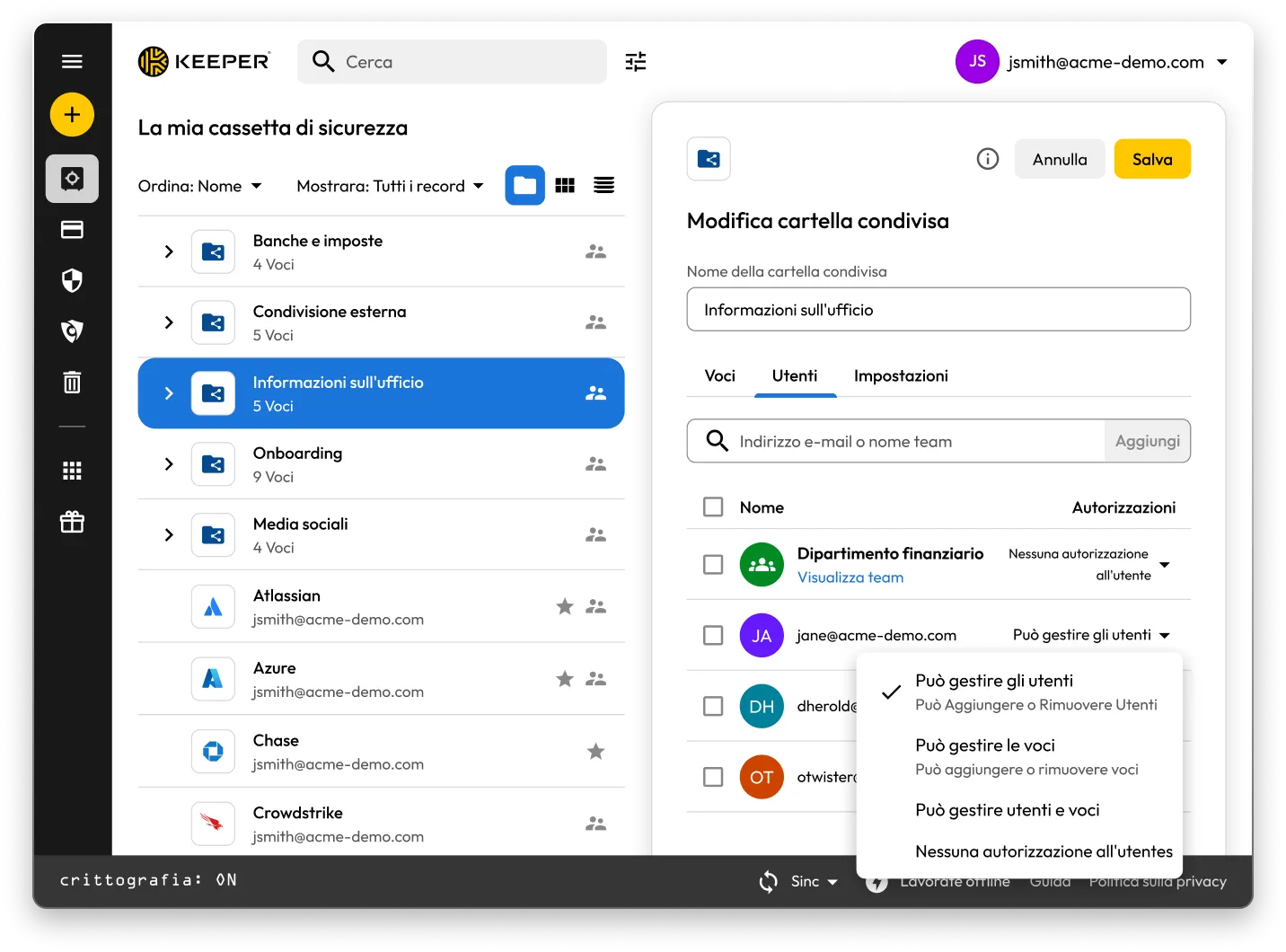
Interfaccia della cassaforte Keeper che mostra cartelle e voci condivise. Il pannello

Keeper vs 1Password: Side-by-side comparison

Keeper
1Password
Security architecture and encryption model

Keeper's zero-knowledge architecture encrypts every individual record and folder with its own unique AES-256 key, with all encryption and decryption performed locally on the user's device. Keeper's "Transmission Security" adds a second layer – TLS 1.3/1.2 plus an additional 256-bit AES transmission key – covering all data communications, not just authentication. HSM integration in AWS provides super-encryption at rest.

Keeper Forcefield technology protects against memory-based attacks that specifically target password managers.

Keeper's self-managed BreachWatch® dark web monitoring runs entirely within its own infrastructure using an HSM-protected architecture, so breached passwords are never correlated against vault data outside Keeper's systems.

Keeper holds 10 issued U.S. patents covering its zero-knowledge architecture, SSO, breach detection and secure messaging, with four more pending.

Based on publicly available documentation, 1Password uses a vault-key-based encryption model: individual items are encrypted using keys derived from that vault key, rather than each having an independently generated key. Its SRP protocol handles authentication; data in transit is protected by TLS, though this operates separately from 1Password's credential encryption architecture.

For dark web monitoring, 1Password's Watchtower feature integrates with Have I Been Pwned using a k-anonymity API, which transmits only a partial hash rather than the full credential.

1Password provides basic memory protection only, leaving users more exposed to advanced malware techniques that target password managers.

1Password (AgileBits Inc.) holds at least one issued U.S. patent.

Authentication, Single Sign-On (SSO) and provisioning

Keeper uses multi-layered authentication that combines a master password with device verification, providing an approach that is both attack-resistant and simple for end users.

Keeper has been in enterprise SSO production since 2016, holds patents on its SSO implementation and supports complex multi-provider configurations with no additional software required.

SCIM provisioning works directly with any Identity Provider (IdP) without any software installation.

Based on publicly available documentation, 1Password's dual-factor approach, an account password plus a secret key, can introduce complexity and potential access issues.

SSO support has expanded to multiple identity providers, though deployment requires additional configuration steps compared to Keeper's no-software-installation approach.

SCIM provisioning requires deploying a self-hosted SCIM Bridge in either an on-premises or cloud environment, though 1Password now offers hosted provisioning for Entra ID and Okta users.

Platform capabilities and Privileged Access Management (PAM)

KeeperPAM combines enterprise password management, secrets management, connection management, privileged session management and Remote Browser Isolation (RBI) in a single cloud-native, zero-knowledge interface.

Remote Browser Isolation creates isolated browser sessions for internal and cloud applications, eliminating the need for VPNs.

Keeper Endpoint Privilege Manager enforces Just-In-Time (JIT) access and least privilege directly on user devices, with automatic privilege revocation on session termination.

Keeper Secrets Manager is fully cloud-based with CLI, REST APIs, Terraform and CI/CD pipeline support. No on-premises infrastructure is required.

Keeper also offers over 80 distinct permissions across 14 categories for granular enterprise access control.

1Password is a password manager that has expanded into an Extended Access Management platform covering device trust, SaaS visibility and app access governance. It does not offer the privileged access management capabilities that enterprises typically require, including RBI, JIT or zero-standing privilege capabilities, or the ability to enforce least privilege on endpoints.

For secrets management, 1Password Secrets Automation offers two paths: Service Accounts for lighter use cases or a self-hosted Connect Server deployed in the customer's own infrastructure for teams needing more control, scalability and higher request limits. Both require configuration and ongoing maintenance within the customer's environment.

1Password has 12 vault-based permissions with limited granularity for enterprise access control.

Database access management

KeeperDB provides secure, zero-knowledge remote access to databases, including MySQL, PostgreSQL, SQL Server and more, directly through the browser with no client software required. Access is governed by role-based policies, full session recording and audit logging, ensuring every database interaction is tracked and compliant. Credential injection means users never see or handle the underlying database passwords directly.

Based on publicly available documentation, 1Password has no database access or management capabilities. Organizations using 1Password for database credentials must rely on manual credential retrieval and separate tooling to manage and audit database sessions, with no native session recording or policy enforcement.

AI-powered security and automation

KeeperAI brings intelligent automation to privileged access management. It monitors privileged sessions in real time and can automatically terminate a session when suspicious activity is detected. KeeperAI also assists with policy creation, access reviews and anomaly detection, reducing the manual overhead of managing a large privileged access environment while continuously strengthening security posture.

Based on publicly available documentation, 1Password has no AI-powered privileged session monitoring, real-time anomaly detection within sessions or automated security response capabilities such as automatic session termination upon detecting suspicious activity.

While 1Password's recently launched Unified Access platform provides credential audit trails and visibility into AI agent activity, it does not offer the integrated session intelligence that KeeperAI delivers natively within a full PAM platform.

Sharing, account management and MSP

Keeper supports time-limited record and folder sharing with automatic credential rotation, plus bidirectional one-time sharing to both users and non-users with real-time sync. Its node-based organizational architecture supports isolation between business units and multiple identity providers within the same tenant.

Enterprises have multiple account recovery pathways, including SSO Recovery, Account Transfer Policy, a 24-word recovery phrase and Commander CLI automation.

Keeper's MSP platform, launched in 2019, combines password management with full PAM capabilities in a unified, multi-tenant interface.

1Password requires users to create separate vaults for sharing, producing copies of records rather than real-time, synced data. It has no node structure or organizational units, and guest accounts are limited to a single vault with no time controls or automated security measures.

There is no direct vault transfer between user accounts, and offboarding relies on employees manually moving items before they leave, with account recovery as an admin fallback that requires access to the departing employee's email address.

1Password's MSP offering focuses solely on password management with no PAM features.

Compliance and certifications

Keeper is FedRAMP High Certified and GovRAMP High Authorized, FIPS 140-3 validated, ISO 27001/17/18 certified, ITAR compliant and holds the longest-standing SOC 2 Type II certification in the industry.

Based on publicly available information, 1Password holds no FedRAMP, GovRAMP or FIPS authorization, limiting its use in regulated industries and government.

*Dati al 27 ottobre 2025

Keeper VS 1Password. Valutazioni e recensioni degli utenti

Keeper
1Password
App Store iOS

App Store iOS

4,9 su 5 e 224.000 recensioni

4,9 su 5 e 224.000 recensioni

4.6 out of 5 and 20K Reviews

4.6 out of 5 and 20K Reviews

App su Microsoft Store

App su Microsoft Store

4,9 su 5 e 1.460 recensioni

4,9 su 5 e 1.460 recensioni

4.4 out of 5 and 10 Reviews

4.4 out of 5 and 10 Reviews

Estensione di Chrome

Estensione di Chrome

4,8 su 5 e 8.500 recensioni

4,8 su 5 e 8.500 recensioni

2.9 out of 5 and 2,700 Reviews

2.9 out of 5 and 2,700 Reviews

Android

Android

4,7 su 5 e 110.000 recensioni

4,7 su 5 e 110.000 recensioni

3.5 out of 5 and 17.6K Reviews

3.5 out of 5 and 17.6K Reviews

*Dati al 27 ottobre 2025

Usate già 1Password? Passate a Keeper, è facile.

Spostare le password da 1Password a Keeper è semplice e sicuro. Bastano pochi clic per eseguire la migrazione a Keeper delle informazioni memorizzate in 1Password, comprese le password, le cartelle, le sottocartelle, i campi personalizzati, i codici TOTP, gli appunti e gli account.

Domande frequenti

Come faccio a importare le password da 1Password a Keeper?

È possibile importare le password da 1Password a Keeper Security procedendo semplicemente come segue:

  • Accedi al tuo account di 1Password
  • Seleziona l'area password o l'abbonamento che desideri
  • Esporta i dati
  • Accedi a Keeper sul web o nell'app per desktop
  • Fai clic sull'icona del tuo account > Impostazioni > Importa
  • Seleziona 1Password dall'elenco e trascina il file esportato nella finestra "Trascina qui un file"

Scopri di più sull'importazione da 1Password con questa guida passo-passo in base al dispositivo.

Come faccio a cancellarmi da 1Password?

Se non desideri più mantenere l'abbonamento a 1Password, procedi come segue in tre passi:

  • Accedi al tuo account di 1Password.
  • Nell'angolo in alto a destra, seleziona il tuo nome e fai clic su Il mio profilo.
  • In fondo alla pagina, seleziona Elimina l'account in modo permanente.

Ricordati di esportare le tue credenziali e poi di importarle nell'alternativa a 1Password che preferisci prima di chiudere l'account.

Keeper è una piattaforma PAM completa. Significa forse che è destinata solo alle grandi imprese?

No. Keeper offre funzionalità PAM complete che rispondono alle esigenze delle aziende, ma è stato progettato per adattarsi ai singoli utenti come alle grandi organizzazioni.

Keeper Business offre alle piccole aziende una soluzione di gestione delle credenziali snella e facile da usare, senza compromettere la sicurezza.

Keeper offre anche piani personalizzati per la gestione delle password individuali e l''archiviazione sicura dei file, oltre a piani familiari per la gestione delle password condivise tra i membri della famiglia.

L''architettura flessibile della piattaforma consente agli utenti di iniziare con una gestione di base delle password e di passare a funzionalità PAM di livello aziendale con la progressiva crescita delle esigenze. Ciò significa che gli individui possono beneficiare della stessa base di sicurezza che caratterizza le soluzioni di Keeper Business, mentre le organizzazioni possono accedere secondo necessità a sofisticati controlli degli accessi con privilegi.

Pacchetto 1Password Family VS pacchetto Keeper Family: che differenza c'è?

Keeper Family consente di proteggere e condividere un numero illimitato di password per le famiglie con cinque cassette di sicurezza private, 10 GB di spazio di archiviazione per i file, dispositivi illimitati, accesso di emergenza e assistenza 24 ore su 24, 7 giorni su 7. Keeper Family costa solo al mese.

1Password consente anche alle famiglie di archiviare in modo sicuro le password, esportare dati e condividere le password, ma richiede la creazione di più casseforti per la condivisione. Keeper consente la condivisione di voci singole e di cartelle. 1Password offre solo 1 GB di spazio di archiviazione per i documenti, mentre Keeper ne offre uno da 10GB.

Nega il consenso sui cookieLa tua privacy è importante

Utilizziamo i cookie sul nostro sito per offrirti la migliore esperienza di navigazione, pubblicare annunci personalizzati sui nostri prodotti e contenuti e analizzare il traffico del sito web. Per ulteriori informazioni, consulta la nostra Informativa sulla privacy.

Registratevi per una prova gratuita

Acquista ora