Keeper® vs Teleport: The best Teleport alternative

Keeper and Teleport both secure infrastructure access, but for different audiences and with fundamentally different approaches. See how they compare across platform depth, compliance, deployment and enterprise capability.

Demander une démo
Keeper® vs Teleport: The best Teleport alternative

What makes Keeper the best Teleport alternative?

Keeper = Haute sécurité
Teleport
Platform identity and scope

Keeper is a unified identity security platform covering the full enterprise security stack, including enterprise password management, privileged session management, secrets management, Remote Browser Isolation (RBI), endpoint privilege management, AI-powered threat detection and secure database access, all in one cloud-native platform with one vault, one admin console and one policy engine.

Teleport is an infrastructure access platform built for software engineers, DevOps and security teams. It provides certificate-based access to servers, databases, Kubernetes clusters, internal web applications and Git repositories, replacing SSH keys and VPNs with short-lived cryptographic certificates.

Based on publicly available documentation, Teleport is purpose-built for infrastructure access, not broad enterprise PAM. It does not offer enterprise password management, credential vaulting for end users, endpoint privilege management, remote browser isolation or dark web monitoring.

Deployment model and operational complexity

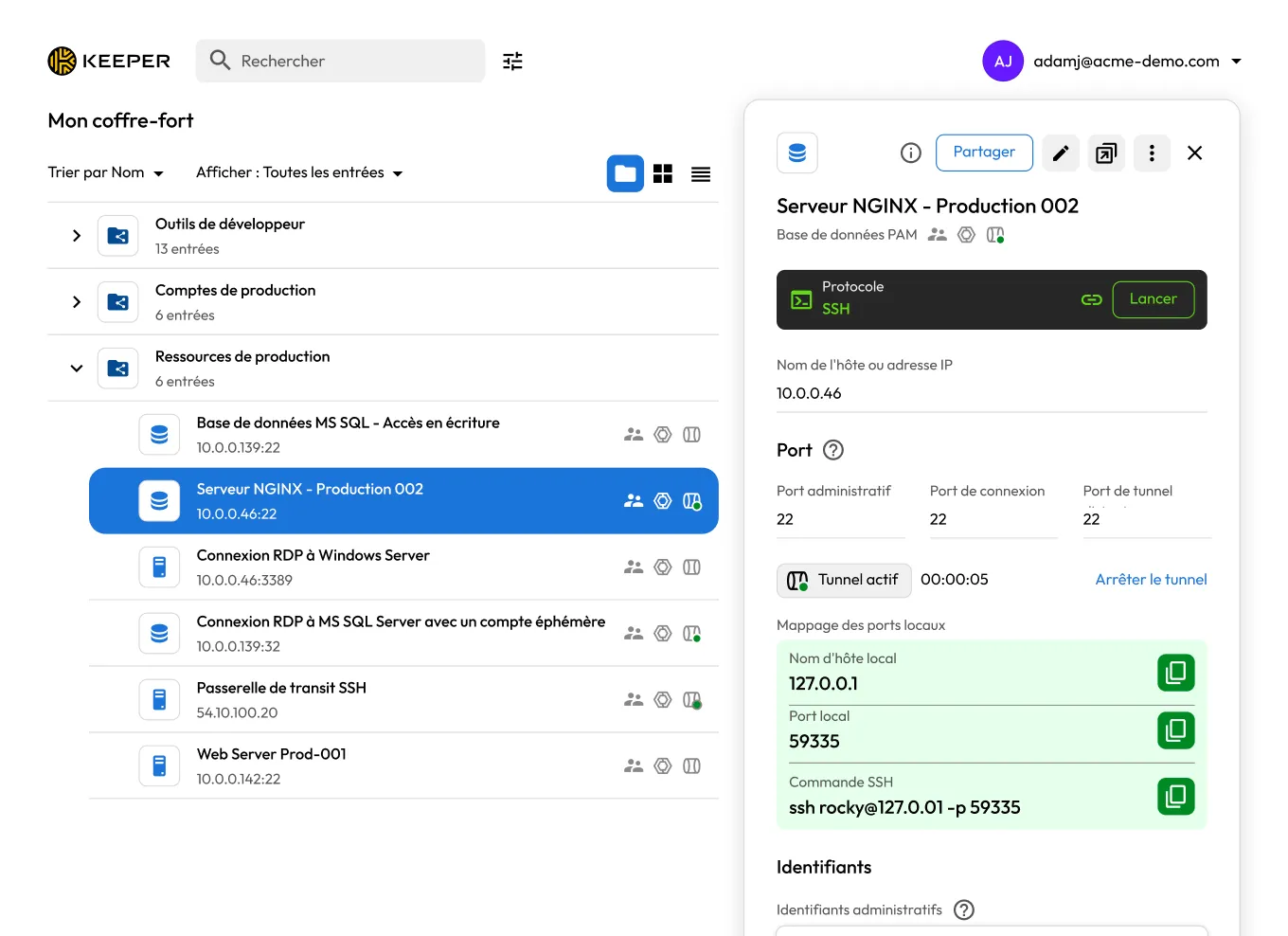
Keeper is 100% agentless and clientless for privileged session management. A lightweight, containerized Keeper Gateway is deployed in the target environment; no software needs to be installed on individual endpoints, no agents on every server and no inbound firewall changes are required.

The gateway is outbound-only by design. Users access infrastructure directly through the Keeper Vault with no reconfiguration of existing systems.

Teleport requires the installation of agent software (the Teleport daemon) on every endpoint that will be accessed, though some resource types support an agentless mode. Self-hosted deployments also require running an Auth Service and a Proxy Service.

RDP access has the highest setup cost. Teleport authenticates over RDP using a virtual smart card, which requires domain controller access, GPO changes, importing the Teleport CA into the Windows trust store and publishing it to the AD NTAuth store.

Teleport's own documentation flags that Windows PKI can be difficult to configure and that some environments require significant changes to support smart card authentication.

Teleport Enterprise Cloud reduces this burden for teams that don't want to run their own Auth Server; the cluster is managed for you, and you only need to deploy agents.

Zero-knowledge security architecture

Keeper is built on a zero-knowledge, zero-trust architecture. All encryption is performed client-side before data reaches Keeper's servers. Keeper has no ability to access customer vault data, credentials or secrets. Every record is protected by its own unique AES-256 key generated locally on the user's device.

Keeper's cryptographic module is FIPS 140-3 validated by the NIST Cryptographic Module Validation Program (CMVP).

Based on publicly available documentation, Teleport's certificate model eliminates long-lived passwords and SSH keys. But the Auth Server holds the User CA signing key, a long-lived credential that, if exfiltrated, would let an attacker mint certificates for any Teleport-managed host. Teleport mitigates this by supporting HSM and cloud KMS storage (AWS, GCP), so the private key never leaves a hardware boundary, but that requires additional configuration.

Compliance certifications and government readiness

Keeper is FedRAMP High Certified and GovRAMP High Authorized, hosted on AWS GovCloud with U.S.-only data storage and a sequestered U.S. Persons-only support team.

Keeper is FIPS 140-3 validated, SOC 2 Type II, SOC 3 and ISO 27001, 27017 and 27018 certified, and supports ITAR and FDA 21 CFR Part 11 compliance. Keeper has implemented quantum-resistant encryption using CRYSTALS-Kyber, future-proofing customer data against post-quantum threats.

Based on publicly available information, Teleport holds SOC 2 and ISO 27001 and 27701 certifications and supports FedRAMP-compliant deployments. Teleport's documentation provides guidance on configuring self-hosted deployments to meet FedRAMP controls.

Teleport is not listed as FedRAMP Certified on the FedRAMP Marketplace and is not independently validated as a cryptographic module under FIPS 140-3. Its FIPS builds rely on Google's BoringCrypto (CMVP certificate #4735), which holds the FIPS 140-3 validation.

Privileged session management and session recording

Keeper provides full privileged session management across SSH, RDP, VNC, database sessions and remote browser sessions, all from the Keeper Vault with no agent on the target system. Every session is fully recorded end-to-end, encrypted with unique per-session keys and stored in the customer-managed vault.

Recordings are decrypted locally in the user's vault, maintaining strict zero-knowledge access controls. Administrators can search session content, review keystroke logs and replay recordings directly from the vault, with every event available for Security Information and Event Management (SIEM) integration.

Based on publicly available documentation, Teleport provides session recording for SSH, Kubernetes, database and web application sessions. RDP session recording is available but requires a more complex setup.

All connections are proxied through Teleport's infrastructure, and session recordings are stored on the Auth Server or a configured storage backend. Access to those recordings is controlled by whoever administers the Auth Server; there is no encryption model that restricts access below that trust boundary.

AI-powered threat detection

Keeper provides KeeperAI, an agentic AI engine embedded within KeeperPAM® that monitors active privileged sessions in real time across SSH, RDP, VNC, RBI, database connections and KeeperDB. It analyzes keystroke logs and command execution, classifies behavior by risk level, and automatically terminates sessions when a threat is detected — without human intervention.

Built on a Sovereign AI framework, each organization retains full data ownership with flexible on-premises or cloud LLM deployment options.

Teleport introduced AI-generated session summaries in version 18.2 (September 2025). The feature produces natural-language summaries of SSH, Kubernetes and database session logs using an LLM. It requires Teleport Enterprise with Identity Security enabled, which is disabled by default and relies on an external inference provider (OpenAI or Amazon Bedrock) or a Teleport-managed model on Cloud.

Teleport has also launched an Agentic Identity Framework for governing AI agent access to infrastructure, applying the same certificate-based model used for human and machine identities to LLMs, MCP servers and agentic workflows.

Secrets management

Keeper Secrets Manager is a fully cloud-based, zero-knowledge secrets management solution requiring no on-premises components. It secures API keys, SSH keys, certificates, database passwords and CI/CD pipeline credentials with built-in automated rotation.

It integrates natively with Terraform, Kubernetes, GitHub Actions, Jenkins and over 100 DevOps tools and supports the Model Context Protocol (MCP), so AI tools and agents can securely retrieve secrets.

Teleport takes a fundamentally different approach to secrets: rather than vaulting and rotating credentials, Teleport eliminates long-lived credentials entirely by issuing short-lived certificates on demand.

Teleport does not offer a credential vault or secrets management solution for the broader class of secrets that organizations need to manage, such as API keys, third-party service credentials, certificates and other confidential data that cannot be replaced with short-lived certificates.

Enterprise password management and end-user coverage

Keeper Enterprise Password Manager covers every user in the organization, not just engineering teams. It's accessible via web vault, desktop apps, mobile apps and browser extensions across all major platforms.

Keeper delivers a consistent experience for both privileged administrators and everyday employees. KeeperFill autofills passwords, passkeys and 2FA codes. BreachWatch® monitors the dark web for exposed credentials.

Teleport is designed for infrastructure engineers and does not offer enterprise password management for general business users. It has no vault for storing end-user credentials, no autofill for SaaS applications, no dark web monitoring and no mobile vault app for employees.

Organizations that deploy Teleport for their engineering teams still need a separate password management solution for the rest of the workforce.

Secure database access

Keeper provides KeeperDB, a built-in database management interface inside the Keeper Vault. Privileged users can securely query and manage MySQL, PostgreSQL, Microsoft SQL Server databases or connect through third-party database tools, without credentials touching a local device.

Every session runs inside Keeper Remote Browser Isolation, is fully recorded, and is governed by centralized least-privilege policies with a complete audit trail. Administrators can enforce read-only sessions, time-limited access, and data export controls from a single console.

Teleport provides database access proxying for MySQL, PostgreSQL, MongoDB, Redis, Oracle and other databases, routing connections through Teleport's proxy so that short-lived certificates replace database credentials. Session activity is logged and recorded.

Teleport does not provide a native browser-based query environment. Users connect via external GUI clients such as pgAdmin or MySQL Workbench, tunneled through Teleport's local proxy. There is no integrated visual query interface in the Teleport web UI.

Reporting, auditing and SIEM integration

Keeper's Advanced Reporting & Alerts Module (ARAM) tracks over 300 auditable events, including vault activity, privileged sessions, secrets access and policy changes, with real-time alerting and direct SIEM integration into CrowdStrike Falcon, Microsoft Sentinel, Google Security Operations and Splunk.

Keeper's Compliance Reporting module provides consolidated, audit-ready reports for SOC 2, HIPAA, PCI DSS and ISO 27001 from the same console.

Teleport provides audit logs for all infrastructure access events, including sessions, logins, access requests and policy changes, with SIEM integration available via its Events API and native integrations with platforms like Elastic and Splunk.

Because Teleport has no password vault or end-user credential layer, its audit scope is limited to infrastructure access. It does not track password events, vault activity, end-user credential behavior or organization-wide security posture.

Keeper vs Teleport: User ratings and reviews

Keeper = Haute sécurité
Teleport
iOS App Store

iOS App Store

4.9 out of 5 and 224,000 Reviews

4.9 out of 5 and 224,000 Reviews

5,0 sur 5

No dedicated app

Appli Microsoft Store

Appli Microsoft Store

4.9 out of 5 and 1,460 Reviews

4.9 out of 5 and 1,460 Reviews

5,0 sur 5

No dedicated app

Extension Chrome

Extension Chrome

4.8 out of 5 and 8,500 Reviews

4.8 out of 5 and 8,500 Reviews

5,0 sur 5

No dedicated app

Android

Android

4.7 out of 5 and 110,000 Reviews

4.7 out of 5 and 110,000 Reviews

5,0 sur 5

No dedicated app

*Data as of April 15, 2026

Infrastructure access is just the beginning

KeeperPAM goes further than Teleport, protecting every user, every credential, every privileged session and every secret across your organization, all under one zero-knowledge, zero-trust platform.

Foire aux questions

What is Teleport, and who uses it?

Teleport is an open-source infrastructure access platform providing certificate-based access to servers, databases, Kubernetes clusters and internal web applications, replacing long-lived SSH keys and passwords with short-lived cryptographic certificates. It is widely used by software engineers, DevOps teams and platform engineers in cloud-native environments.

Teleport is a strong tool for engineering-led organizations that want to eliminate credential-based access to infrastructure. It is not a full privileged access management platform. It does not offer enterprise password management, credential vaulting for end users, endpoint privilege management, remote browser isolation or the compliance certifications required for government and regulated enterprise procurement.

How does KeeperPAM differ from Teleport?

The core difference is scope. Teleport is an infrastructure access tool designed for engineering teams; its strength is replacing SSH keys and VPNs with certificate-based access for developers accessing servers, databases and Kubernetes clusters.

KeeperPAM is a unified identity security platform that covers the entire organization. It delivers enterprise password management for all users, privileged session management, secrets management, remote browser isolation, endpoint privilege management, AI-powered threat detection with KeeperAI and secure database access with KeeperDB, all under a single zero-knowledge architecture with FedRAMP High Certification and FIPS 140-3 validated cryptography. Organizations that deploy Teleport for their engineering teams still need a separate solution for password management, end-user credential security, compliance reporting and endpoint privilege management. Keeper covers all of it in one platform.

Is Keeper easier to deploy than Teleport?

Yes, significantly. Keeper's privileged session management is 100% agentless and clientless; a lightweight, containerized gateway is deployed in the target environment, and no software needs to be installed on individual endpoints. The gateway is outbound-only and requires no inbound firewall changes. Most organizations are fully operational within a day.

Teleport requires installing agent software on every endpoint that will be accessed, plus an Auth Service and Proxy Service. RDP access requires additional steps, including domain controller access, GPO changes and Smart Card API configuration. Teleport Enterprise Cloud reduces some of this complexity for teams using the managed option, but self-hosted deployments carry significant operational overhead.

Is Keeper compliant with government and regulated industry requirements?

Yes, Keeper is FedRAMP High Certified and GovRAMP High Authorized, FIPS 140-3 validated, SOC 2 Type II, SOC 3 and ISO 27001, 27017 and 27018 certified, and supports ITAR and FDA 21 CFR Part 11 compliance. Keeper has also implemented quantum-resistant encryption using CRYSTALS-Kyber.

Teleport holds SOC 2 and ISO 27001 and 27701 certifications and provides documentation to help customers configure self-hosted deployments to meet FedRAMP controls. However, Teleport is not itself listed as FedRAMP Authorized on the FedRAMP Marketplace and is not FedRAMP High Certified. For government agencies and regulated enterprises where FedRAMP Certification is a hard procurement requirement, Keeper is the only viable choice.

Can Keeper and Teleport be used together?

Yes, they are not mutually exclusive, and some organizations may use both. Teleport's secretless, certificate-based model is a strong fit for engineering teams accessing cloud infrastructure, while Keeper covers the broader identity security needs of the organization: end-user password management, secrets storage, privileged session management for non-engineering users, compliance reporting and endpoint privilege management.

That said, KeeperPAM covers the same infrastructure access use cases Teleport does, such as agentless remote access over SSH, RDP and database protocols, with full session recording and zero-knowledge security. For organizations evaluating both, Keeper can replace Teleport entirely while extending security to every user and every credential in the organization, under a single platform with stronger compliance credentials.

Retirer l'autorisation d'utilisation de cookiesNous accordons de l'importance à votre vie privée

Nous utilisons des cookies sur notre site pour vous offrir la meilleure expérience de navigation possible, vous proposer des publicités personnalisées sur nos produits et notre contenu, et analyser le trafic sur le site Web. Pour en savoir plus, veuillez consulter notre politique de confidentialité.

Inscrivez-vous pour bénéficier d'un essai gratuit

Acheter maintenant