
Keeper vs AutoElevate: Identity security platform comparison
CyberFOX bolts together separate tools for each problem. KeeperPAM unifies password management, endpoint privilege management and privileged access in one zero-trust platform.
CyberFOX bolts together separate tools for each problem. KeeperPAM unifies password management, endpoint privilege management and privileged access in one zero-trust platform.
Analysis is based on publicly available documentation and information as of August 12, 2026.

KeeperPAM brings together enterprise password management, secrets management, privileged session management, Remote Browser Isolation (RBI) and endpoint privilege management into one zero-knowledge platform. No secondary tools, no platform switching and full coverage across all devices and operating systems.
Because everything lives in a single console, MSP technicians can manage credentials, approve elevation requests and review session recordings from the same place without managing multiple products and vendor relationships.
CyberFOX's platform is assembled from three separate products: AutoElevate for Windows endpoint privilege management, Password Boss for password management and CyberFOX DNS Filtering. Each runs on its own platform with its own interface; there is no unified vault or single console that includes all three components.
AutoElevate provides good coverage for Windows endpoints, but macOS is in early access, and Linux is not supported. Password Boss adds multi-tenant password management with 2FA and PSA integration. DNS Filtering provides AI-powered content and threat blocking. Together, they address common MSP needs, but as separate tools rather than as a comprehensive platform.
Keeper's Endpoint Privilege Manager deploys a lightweight agent that removes standing local admin rights and replaces them with temporary, policy-based elevation. Elevation is granted at the process level, not the machine level, so users get the exact access they need for a particular task for a specific window of time. Just-In-Time (JIT) access applies at both the process and machine levels, with automatic expiration and full escalation workflow support.
Because Endpoint Privilege Manager sits inside the same KeeperPAM platform, elevation requests, approvals and audit logs flow into the same console as credential vaulting, session recording and secrets management. Elevation data is encrypted locally and accessible only to authorized administrators through the Keeper Admin Console, governed by the same zero-trust, zero-knowledge architecture as the rest of the platform.
AutoElevate handles Windows UAC elevation well. It removes local admin rights, manages elevation requests in real time and gives MSP technicians a mobile app to approve requests on the go. For day-to-day help desk operations on Windows endpoints, it does the job with minimal setup and low overhead.
macOS support is in early access, and Linux is not supported. Elevation approvals and audit logs are scoped to AutoElevate's own interface and don't connect to Password Boss or DNS Filtering. This means there is no unified policy engine or shared audit trail across the CyberFOX product suite.
Every privileged session in Keeper is recorded and stored as immutable, exportable audit evidence across all tenants. KeeperAI® monitors sessions in real time and can automatically terminate any session where suspicious activity is detected.
Clients can be granted direct access to session recordings and audit logs, which makes compliance requirements and dispute resolution straightforward.
None of CyberFOX's products, AutoElevate, Password Boss or DNS Filtering, includes privileged session recording. When AutoElevate logs that an application was approved for elevation, it does not record what happened inside the session — there is no video or keystroke playback of the technician's actions.
Clients who need visibility into what was done on their systems rely on MSP-provided reports or service tickets rather than session recordings.
KeeperAI is embedded directly into KeeperPAM's privileged session layer. It analyzes session activity in real time, classifies risk as it happens and can automatically terminate high-risk sessions before damage is done. Every guardrail decision is logged as part of the session's immutable audit record.
Beyond threat response, KeeperAI generates encrypted, forensic-ready summaries of session activity, giving security teams and auditors a plain-language account of what happened in each privileged session without having to scrub through full recordings.
CyberFOX DNS Filtering uses AI pattern recognition to identify and block malicious domains in real time. Neither AutoElevate nor Password Boss includes AI-driven threat detection of any kind.
There is no automated mechanism across the CyberFOX platform to detect or respond to anomalous behavior inside a privileged session. Identifying suspicious activity after access is granted depends entirely on human review of logs after the fact.
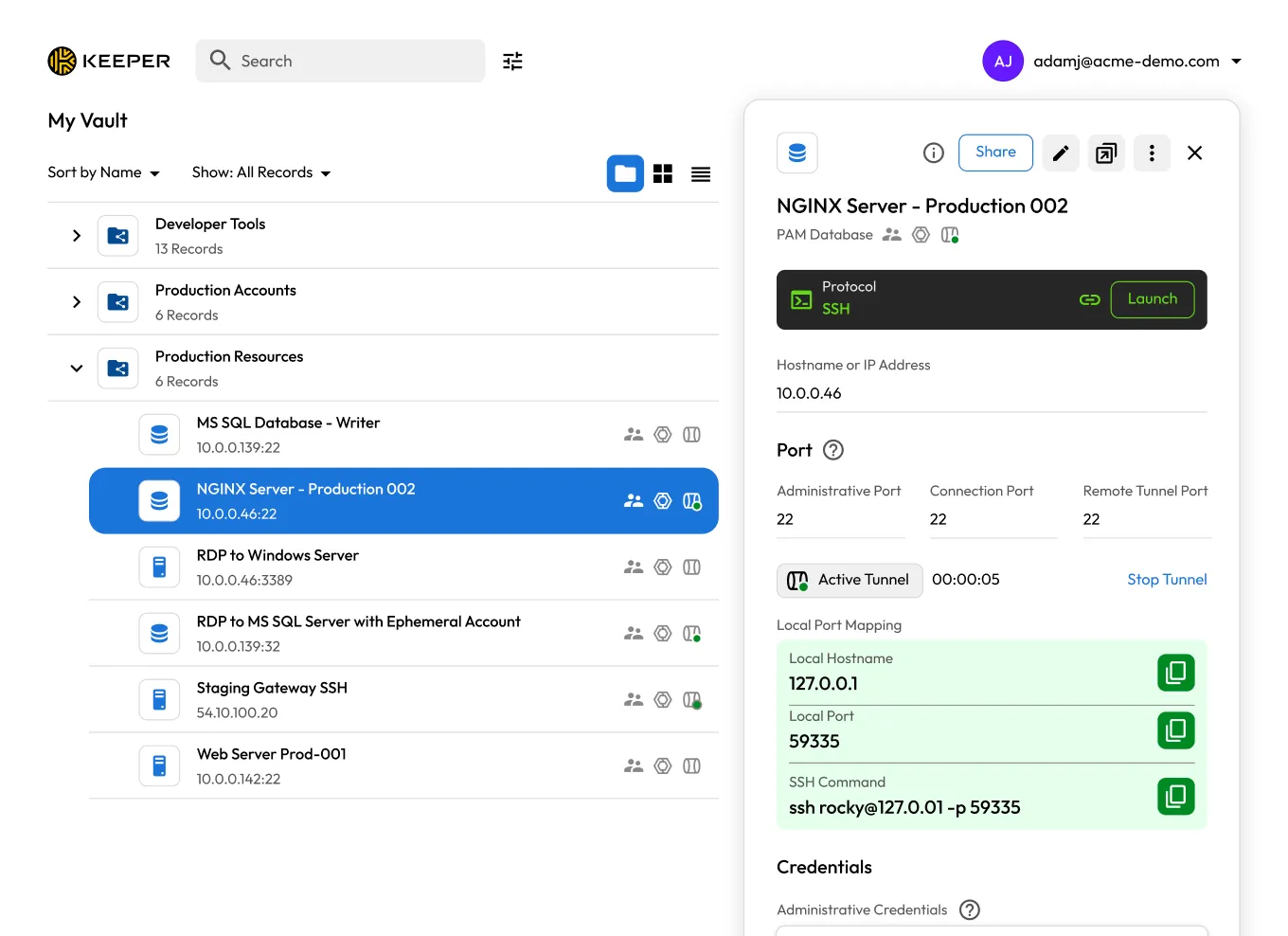
KeeperDB is a full-featured database management interface that runs as a fully governed, embedded session inside the Keeper Vault. Developers and DBAs can launch sessions for PostgreSQL, MySQL, SQL Server, Oracle, Amazon Redshift and SQLite directly from a database record, with credentials decrypted in the Keeper Gateway and never revealed or stored on the user's device. All activity runs through Keeper's Remote Browser Isolation layer, so the connection is fully contained and governed from the start.
When launched from the vault, every KeeperDB session is fully recorded, with KeeperAI monitoring activity in real time. Granular controls like read-only access and governed data transfer policies reduce exfiltration risk. For teams that prefer their existing tools, a proxy mode allows connections through pgAdmin, MySQL Workbench, DBeaver and similar clients while still routing through Keeper's infrastructure for policy enforcement and session recording.
None of CyberFOX's three products include database access management. In a CyberFOX environment, database credentials are managed outside the CyberFOX tools, so they fall outside its access controls, session recording and auditing.
Keeper's database access management adds brokered connections, session recording and least-privilege controls for database access, which CyberFOX does not provide.
Keeper supports Just-In-Time (JIT) access with automatic expiration, multi-step approval workflows, time-bound access and native integration with Slack, Jira and ServiceNow. Approvals happen in the tools MSP teams already use, without requiring a separate login.
Granular Role-Based Access Control (RBAC) applies least-privilege policies to both MSP technicians and client users. Keeper never exposes credentials during an access grant; the session launches without the technician seeing the underlying password.
AutoElevate's workflow is a one-step approval by an MSP technician, with the option to set "allow always" rules for recurring requests. Password Boss handles credential sharing through its own separate interface. The two products do not share a policy engine or a unified approval workflow.
For clients that need multi-party approvals for sensitive requests, time-bound access or integration with IT service management workflows, CyberFOX does not offer those controls.
Keeper is built on a zero-knowledge and zero-trust security architecture. Vault data is encrypted and decrypted locally on the user's device using AES-256 encryption, and Keeper's servers store ciphertext rather than plaintext credentials or vault contents. Keeper's cryptographic module is FIPS 140-3 validated, giving MSPs a stronger assurance layer for regulated and security-conscious clients.
Keeper also extends zero-trust controls into privileged access workflows. Access can be governed by identity, role, policy and approval requirements before a privileged session or connection is opened. Credentials do not need to be exposed to technicians, and JIT access can be limited to the approved task or session. Keeper integrates with major identity providers, including Microsoft Entra ID, Okta and Ping Identity, with SSO and provisioning support that ties access decisions back to verified enterprise identity.
AutoElevate is not a zero-knowledge vault product; it is an endpoint privilege management platform. Its security architecture is based on removing standing local admin rights, enforcing least privilege and routing elevation requests through policy-based approval workflows. Zero-knowledge encryption applies to Password Boss, CyberFOX's separate password manager, not to AutoElevate.
AutoElevate supports real-time approvals, trusted application rules, technician permissions and Just-in-Time Admin Login, with administrative access managed through the AutoElevate portal.
Keeper is FedRAMP High Certified and GovRAMP High Authorized. It holds SOC 2 Type II, ISO 27001, 27017 and 27018 certifications, and is HIPAA and PCI DSS compliant.
CyberFOX holds SOC 2 Type II and SOC 3 attestations and ISO/IEC 27001:2022 certification covering its AutoElevate and Password Boss products, and has completed a CMMC Level 1 self-assessment.
CyberFOX is not FedRAMP Certified or GovRAMP Authorized.

iOS App Store

Microsoft Store

Chrome Extension

Android
See how KeeperPAM helps MSPs centralize visibility and control across identity security.
CyberFOX AutoElevate is an endpoint privilege management tool for Windows environments. It removes local admin rights from users, then controls how they request and receive elevated access. When someone needs to run an app that requires admin permissions, AutoElevate routes the request through a policy-based approval workflow; IT or the MSP can approve it once or set a standing rule.
AutoElevate is best described as an endpoint privilege management tool. It removes local admin rights from Windows endpoints and manages UAC elevation requests. For a platform to offer full privileged access management, it must also cover credential vaulting for servers and cloud accounts, privileged session recording, secrets management and compliance reporting. AutoElevate handles one piece of that picture; Keeper handles all of it from a single platform.
No, AutoElevate does not include credential vaulting. CyberFOX offers Password Boss as a separate product on a separate platform for that purpose. Keeper combines enterprise password management and privileged access management in one unified platform, so MSPs don't need to manage multiple vendor relationships, billing cycles or switch between tools when handling different types of privileged access.
AutoElevate logs elevation events; it records that an application was approved for elevation, not what the technician did during the session. Keeper records every privileged session in full: video playback and keystroke logs stored as immutable audit evidence across all tenants. KeeperAI can also monitor sessions in real time and automatically lock a session when suspicious activity is detected. That level of visibility is what compliance auditors and regulated clients require.
Yes, Keeper is FedRAMP High Certified and GovRAMP Authorized, ISO 27001 certified and HIPAA and PCI DSS compliant. That combination supports work with healthcare, financial services, and federal, state and local government clients. CyberFOX holds SOC 2 Type II, SOC 3 and ISO 27001 certifications and has completed a CMMC Level 1 self-assessment, but is not FedRAMP certified or GovRAMP Authorized, which federal and defense procurements typically require.
Zero-knowledge means that all encryption and decryption happen on the user's device. Keeper never has access to vault contents, credentials or session data. For MSPs, it also means you can credibly tell clients that their data is not accessible to anyone outside their own organization. AutoElevate does not use a zero-knowledge model.
Yes, Keeper's endpoint privilege management module covers what AutoElevate does, including Windows UAC elevation, least privilege enforcement and approval workflows, while adding credential vaulting, full session recording, secrets management and compliance coverage in the same platform.
You must accept cookies to use Live Chat.