
 Password




New research shows Microsoft Edge loads all saved passwords into memory in plain text, and Keeper Forcefield is built to protect against exactly this kind of
5 min read
Published on June 24, 2024
Updated on October 3, 2025.
When it comes to staying safe online, one of the simplest and most effective ways is to use a strong password. According to Keeper Security’s Password Management Report, only 25% of respondents use strong, unique passwords for all their online accounts. Unfortunately, many people don’t know exactly what makes a password strong or how long it should be. Generally, your password should be at least 16 characters long; the longer your password, the more difficult it is for cybercriminals to crack it.
Continue reading to learn what makes a strong password, why password length is important and tips for creating long, unique passwords.
Why password length is important
When creating a strong password, both length and complexity are crucial, but length is arguably more important. Although complexity adds protection by including a variety of characters, even a complex but short password can be cracked quickly by cybercriminals, especially with the help of Artificial Intelligence (AI). Simply put, longer passwords create many more possible combinations, making them much more challenging and time-consuming for cybercriminals to guess.
Here’s why password length is crucial:
- Exponential growth in combinations: With the addition of every character, the number of possible combinations exponentially increases, making the password much more resistant to password-based attacks.
- Longer passwords resist brute-force attacks better: Brute-force attacks test every combination of characters until the password is found. The longer your password is, the less effective this method becomes for cybercriminals.
- Even simple, long passwords are stronger than short, complex ones: A password like “thisisareallylongpassword” is harder for cybercriminals to crack than a password like “P@s5w0rd!” solely due to its length.
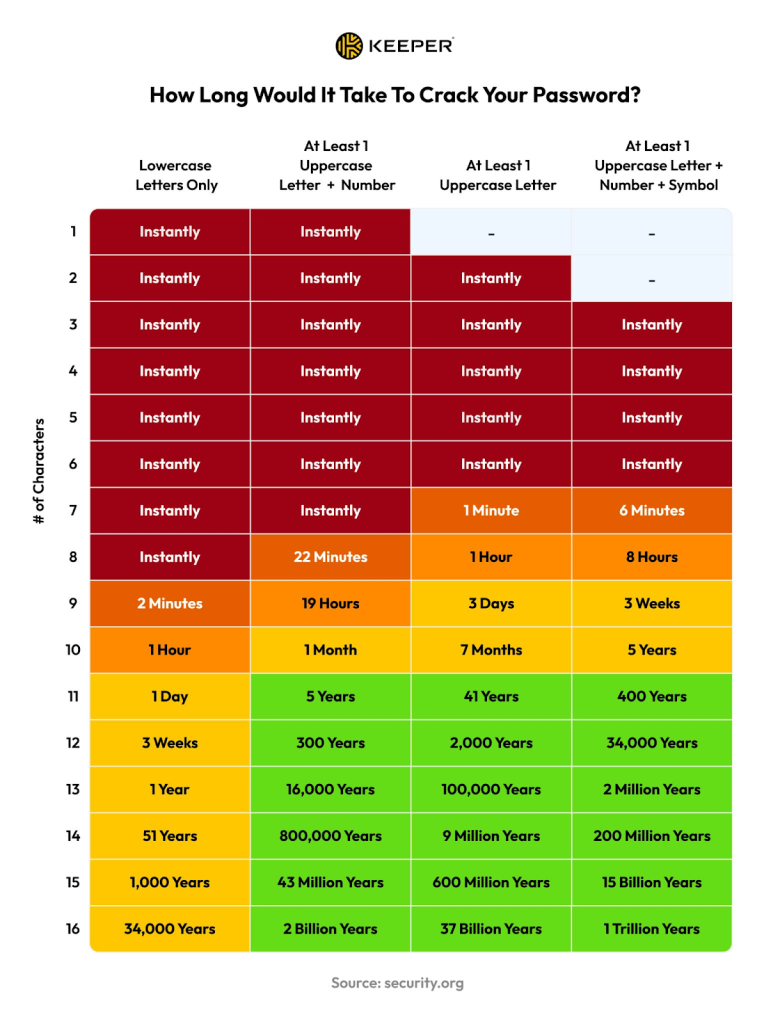
For example, a 10-character password with a variety of characters may take months or even years to crack, but a 16-character password with random characters could take up to one trillion years to crack. Regardless of how long it may take for a cybercriminal to crack your password, we recommend making sure your password is both long and complex for the highest possible security.
4 tips to create and remember long passwords
Long, strong passwords are important for protecting your online accounts, but they can be difficult to create and even more challenging to remember. Luckily, we have some tips that can make creating and remembering your passwords easier:
1. Use a password generator
A password generator is a tool that creates strong, unique passwords with random characters. Generators allow you to adjust the length and types of characters based on your preferred or required password fields. Using a password generator makes it easier to create strong passwords that keep your accounts safe from cyber threats.
2. Create a memorable passphrase
Instead of trying to remember a random cluster of characters, try creating a passphrase — a long sequence of unrelated words. Passphrases are typically longer than passwords because they’re made up of multiple words, ranging from 16 to 100 characters. Using a passphrase combines length, complexity and memorability. As long as you avoid common phrases or quotes and add numbers and symbols to increase security, a strong passphrase can be even more secure than a traditional password.
3. Understand password entropy
Password entropy is a measurement of how challenging it is for a cybercriminal to crack your password. A short password with a mixture of characters may seem strong, but a longer password can have much more entropy. In simple terms, password length increases the number of possibilities, making passwords harder for cybercriminals to guess.
4. Invest in a password manager
While it may be tempting to reuse passwords, especially if they’re long and complex, doing so jeopardizes the safety of all your accounts if just one is compromised. A password manager like Keeper® can solve this problem by helping you generate and store strong, unique passwords for every account. With a password manager, the only password you have to remember is your master password, which acts as a key to unlock your digital vault. Most password managers feature a built-in password generator that generates high-entropy passwords and can automatically fill them in across websites and apps.
Easily create long, complex passwords with Keeper
Securing your online accounts starts with creating a long, complex password. Although complexity matters, password length is the most important factor in defending against brute-force attacks and other cyber threats. By creating a password of at least 16 characters with a combination of uppercase and lowercase letters, numbers and symbols, you significantly minimize your chances of being hacked. Instead of spending hours coming up with random, long passwords, Keeper Password Manager generates and stores strong, unique passwords that fit your required or preferred criteria.
Start your free 30-day trial of Keeper today to begin using long, complex passwords for each of your online accounts.
Frequently asked questions
What is an example of a strong password?
A strong password is at least 16 characters long with a combination of uppercase and lowercase letters, numbers and symbols. A good example of a strong password is something like: iU7A23@cfi83!vyN. If a password like this is too challenging to remember, a strong passphrase is another option, such as: PurpleMonkey_Juice!Snow2. This passphrase is long, includes multiple words and mixes in numbers and symbols.
How often should you change your password?
You should change your password only when necessary, such as after a security breach or if you suspect your account has been compromised. Frequently changing passwords without a valid reason can lead to weaker choices, like easy-to-guess passwords or password reuse. Instead of constantly changing your password, focus on creating a strong, unique password for each of your accounts from the beginning. In addition, use a password manager to keep track of them. By monitoring your accounts for suspicious activity and enabling Multi-Factor Authentication (MFA), you can maintain security without needing to change your password often.

