
 PAM
PAM 




You might treat a centralized vault as the authoritative source for every secret, but secrets can quietly fall out of sync as they get copied into
5 min read
Published on July 28, 2025
As infrastructure becomes more automated and distributed, the number of Non-Human Identities (NHIs) within enterprise environments has quietly surpassed that of human users. These NHIs now play a foundational role in everything from DevOps pipelines to AI-powered workflows, often relying on secrets like API keys, certificates and tokens to access systems and perform critical tasks.
While NHIs are doing more, they’re being secured less. This disconnect is becoming a serious liability, but Keeper can help organizations close that gap.
What are non-human identities, and why do they matter?
Non-human identities are exactly what they sound like: entities that interact with IT systems without human intervention. They deploy apps, access data, connect across environments and execute automated tasks at scale. You’ll find them everywhere, such as in:
- Scripts that provision cloud instances
- Bots that manage workflows
- Kubernetes containers running microservices
- Machine Learning (ML) agents connecting to storage and compute
- Service accounts handling backup jobs and integrations
NHIs play an important role in enterprise operations, but legacy access controls weren’t designed to support the way machines authenticate and communicate today.
Why NHIs pose a growing cybersecurity risk
In cloud-native, DevOps and AI-driven environments, NHIs often outnumber human users. And unlike human identities, they rarely follow structured onboarding, authentication or access controls.
That’s a problem. Here’s why NHIs have become such a high-value target:
- Lack of visibility: NHIs are often created ad hoc, used in automation or embedded deep in infrastructure, making them easy to forget and difficult to monitor.
- Static and hardcoded credentials: Many use default passwords, long-lived tokens or secrets embedded directly into source code, which are easy entry points for cybercriminals.
- Excessive, persistent privilege: Without granular access control, NHIs often have broad, unnecessary permissions and no session limits.
- Limited oversight: Traditional Identity and Access Management (IAM) tools focus on human identities. NHIs often fall outside of formal governance models.
As a result, cybercriminals are increasingly targeting these underprotected identities to escalate privileges, move laterally and maintain long-term access within systems.
The role of secrets management and PAM in NHI security
Protecting NHIs starts with recognizing that their needs and risks are fundamentally different from those of human users. NHIs don’t log in through a User Interface (UI) or use passwords in the traditional sense. They rely on secrets, tokens and machine-to-machine authentication.
That’s where Privileged Access Management (PAM) and secrets management come in. Together, they address the specific challenges of NHI security:
- Secrets management protects sensitive credentials like API keys, SSH keys, certificates and tokens by storing them securely and keeping them out of source code. These secrets are provided only when needed, and access can be limited by user, system or time.
- The privileged access management definition covers who or what can access systems, how access is verified and what actions are permitted. It applies least privilege automatically and ensures full visibility into privileged activity.
Traditional IAM solutions focus on user provisioning and Single Sign-On (SSO), but they lack access control, credential rotation or visibility into machine-based workflows. A PAM solution bridges that gap by delivering Just-in-Time (JIT) access, secrets vaulting and auditability, which are all essential components of a zero-trust strategy for NHIs.
How KeeperPAM secures non-human identities
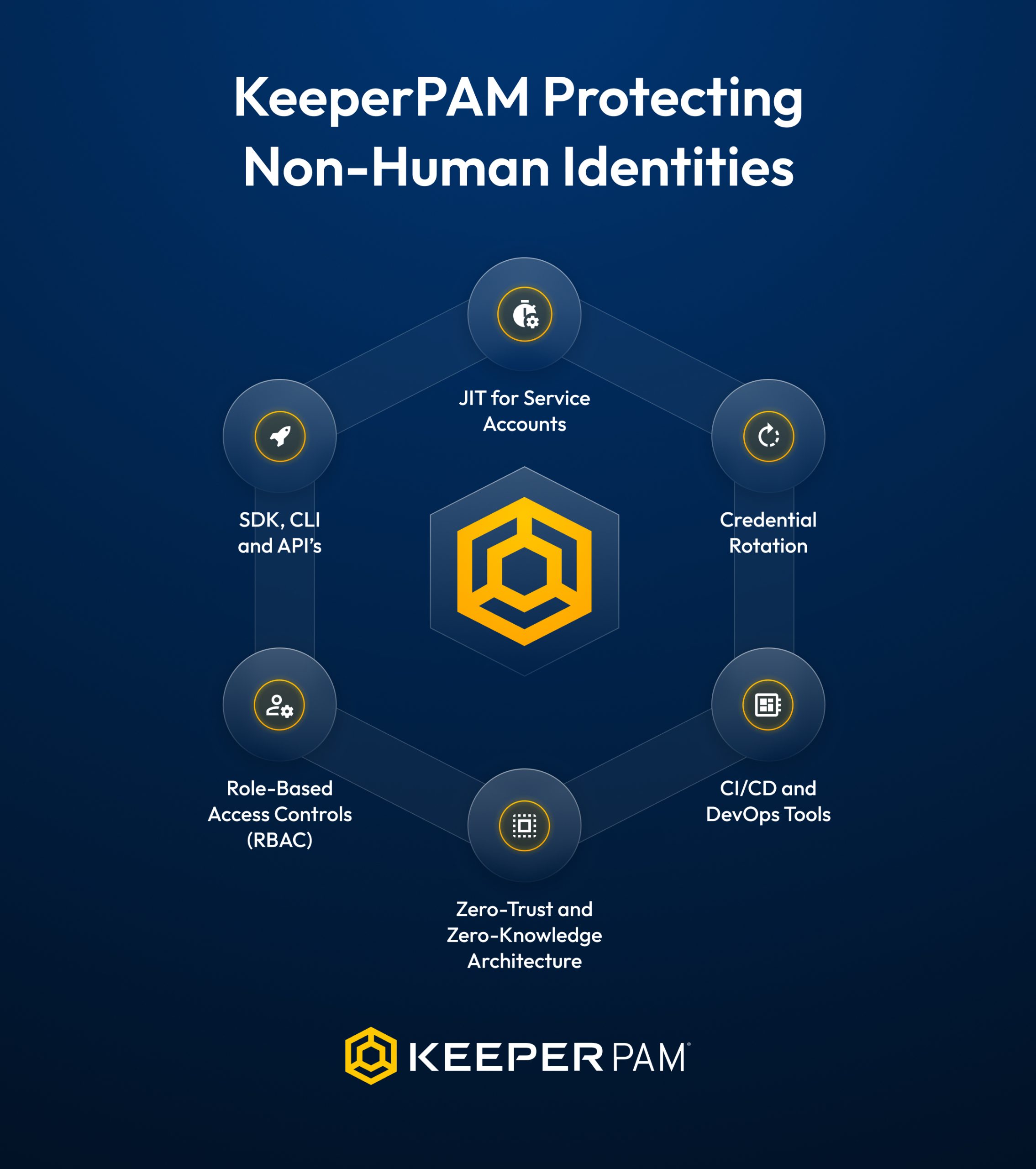
KeeperPAM brings together secrets management, PAM and zero-trust enforcement to provide comprehensive protection for NHIs across cloud, DevOps and hybrid environments. Here’s how:
Secrets management for DevOps pipelines
Keeper Secrets Manager is purpose-built for securing secrets across CI/CD pipelines and automation workflows. Rather than relying on developers to manage credentials manually or embed them in source code, Keeper Secrets Manager provides runtime injection of secrets into tools like Jenkins, GitHub Actions and Terraform. Credentials are encrypted and retrieved only when needed, never stored in plaintext and never exposed to human users.
Keeper Secrets Manager integrates through SDKs, CLI and REST APIs, giving DevOps teams full automation without sacrificing security or compliance.
JIT access for service accounts
KeeperPAM eliminates the need for long-lived credentials by providing JIT access to service accounts and automated systems. Secrets are provisioned only when needed, for a defined time window, and they are automatically revoked once the task is completed. This removes standing access and significantly reduces the attack surface. In addition to JIT, Keeper enforces Just Enough Privilege (JEP), ensuring that machine identities receive only the minimal level of access required to complete a specific task or function. Whether it’s accessing a cloud resource or initiating a database query, permissions are tightly scoped by role, environment and policy.
Together, JIT and JEP ensure NHIs can operate efficiently without overexposure. This is critical in dynamic environments like container orchestration, CI/CD pipelines and ephemeral infrastructure, where security has to keep pace with automation.
Credential rotation for non-human accounts
Credential sprawl and standing access are two of the most common NHI vulnerabilities. KeeperPAM addresses both by automatically rotating passwords, SSH keys and access credentials for service accounts, databases and infrastructure systems. Rotation policies can be scheduled or event-triggered, with complexity requirements and role-based rules.
Zero-trust architecture and session isolation
All infrastructure access, whether initiated by a user or an NHI, is brokered through the Keeper Gateway, a zero-trust access layer that creates end-to-end encrypted tunnels. This approach doesn’t require opening firewall ports or relying on traditional VPNs. Every session, including machine-based connections, can be isolated and recorded for manual review or pushed to a Security Information and Event Management (SIEM) platform. Keeper supports session logging for SSH, RDP, VNC, HTTPS and database protocols.
Role-Based Access Control (RBAC) and policy enforcement
KeeperPAM extends RBAC to machine identities, allowing organizations to enforce least privilege across service accounts, containers and automation tools. Secrets can be scoped down to individual records, folders or apps. Access policies, such as time restrictions, IP filtering and MFA enforcement, ensure each identity has access only to what it truly needs. All NHI activity is logged and available for export to SIEM platforms, making it easier to detect anomalies and meet audit requirements.
Native integrations with cloud infrastructure
Keeper integrates directly with AWS, Azure and Google Cloud to secure cloud-native secrets and non-human access. Organizations can discover and manage IAM users, roles and service accounts across cloud environments, then securely vault their credentials. Secrets used in multi-cloud and hybrid environments are centralized and protected under the same policy controls as human access, helping to streamline security and eliminate credential fragmentation.
Take control of machine-based access with KeeperPAM
Non-human identities aren’t going away; they’re increasing in volume and importance. Securing them requires more than patchwork solutions. KeeperPAM enables your organization to manage secrets, enforce least privilege and deliver zero-trust access to every identity in your environment.
Request a demo to see how KeeperPAM reduces risk by securing every non-human identity in your IT environment.

