What makes Keeper the best One Identity alternative?
Analysis is based on publicly available documentation and information as of August 12, 2026.
Architecture and deployment
KeeperPAM® requires no physical or virtual appliances, no on-premises infrastructure and no dedicated hardware. A lightweight, containerized gateway handles connectivity to target environments through an outbound-only connection, without requiring any inbound firewall changes.
The Keeper Vault, Admin Console all platform capabilities are delivered through the cloud and accessible from any device. Most organizations are fully operational within a day, with no professional services required to reach a production state
Based on publicly available documentation, One Identity's Safeguard PAM suite, which includes Safeguard for Privileged Passwords, Safeguard for Privileged Sessions and Safeguard for Privileged Analytics, runs on dedicated Safeguard appliances, either physical or virtual.
Safeguard On Demand is the SaaS-delivered option, providing a cloud-managed version with reduced infrastructure overhead, although it still requires VPN configuration to connect to the customer's network.
The appliance model is well-suited for organizations with high-assurance, air-gapped or on-premises requirements, but it introduces deployment complexity and infrastructure maintenance overhead that cloud-native deployments avoid.
Zero-knowledge encryption and data confidentiality
Keeper is built on a zero-knowledge, zero-trust architecture. All encryption is performed client-side before data reaches Keeper's servers. Keeper has no ability to access customer vault data, credentials or secrets at any level. Every vault record is protected by its own unique AES-256 key generated locally on the user's device.
Keeper's cryptographic module is FIPS 140-3 validated by the NIST Cryptographic Module Validation Program. This architecture is the reason Keeper has maintained a clean security record across its entire history, with zero breaches and zero regulatory penalties.
Based on publicly available documentation, One Identity does not implement a zero-knowledge architecture. Credentials and session data are centrally managed by the Safeguard appliance which, by design, has access to the data it brokers. This is how the platform performs session proxying, protocol inspection and behavioral analytics.
This is a deliberate architectural choice that enables capabilities like real-time session blocking and screen content analysis. The trade-off is that the Safeguard appliance stores decryptable credential data and is a higher-value target in the event of a compromise compared with a zero-knowledge system, where encrypted data cannot be decrypted by the vendor or the platform.
Government authorization and compliance certifications
Keeper is FedRAMP High Certified and GovRAMP High Authorized, hosted on AWS GovCloud with U.S.-only data storage and a sequestered U.S. Persons-only support team for regulated environments.
Keeper is FIPS 140-3 validated, SOC 2 Type II, SOC 3 and ISO 27001, 27017 and 27018 certified. Keeper supports ITAR and FDA 21 CFR Part 11 compliance and has implemented quantum-resistant encryption using CRYSTALS-Kyber.
Breadth of platform coverage across all users
Keeper is designed for the entire organization, not just IT administrators and privileged users. KeeperPAM unifies enterprise password management, privileged session management, secrets management, remote browser isolation and endpoint privilege management in a single platform.
Every employee gets a full-featured vault with autofill, passkey support and dark web monitoring. Every enterprise user receives a free family plan. Keeper's breadth means organizations can apply consistent identity security from the front-line employee to the most sensitive infrastructure account without deploying separate tools for different users.
One Identity is a PAM-focused platform built for privileged account management, session control and behavioral analytics. It includes a Personal Password Vault feature for business users, but its primary design and depth are oriented toward privileged administrators, IT teams and compliance workflows.
The personal vault caps storage at 100 passwords per user and lacks the browser extension, mobile app experience and consumer-grade usability of a dedicated password manager, meaning organizations deploying Safeguard for privileged access will typically still need a separate password management solution for general employee credential security.
One Identity's broader portfolio, including One Identity Manager for IGA, can address more of the identity stack, although each product requires its own deployment and licensing.
Privileged session management and recording
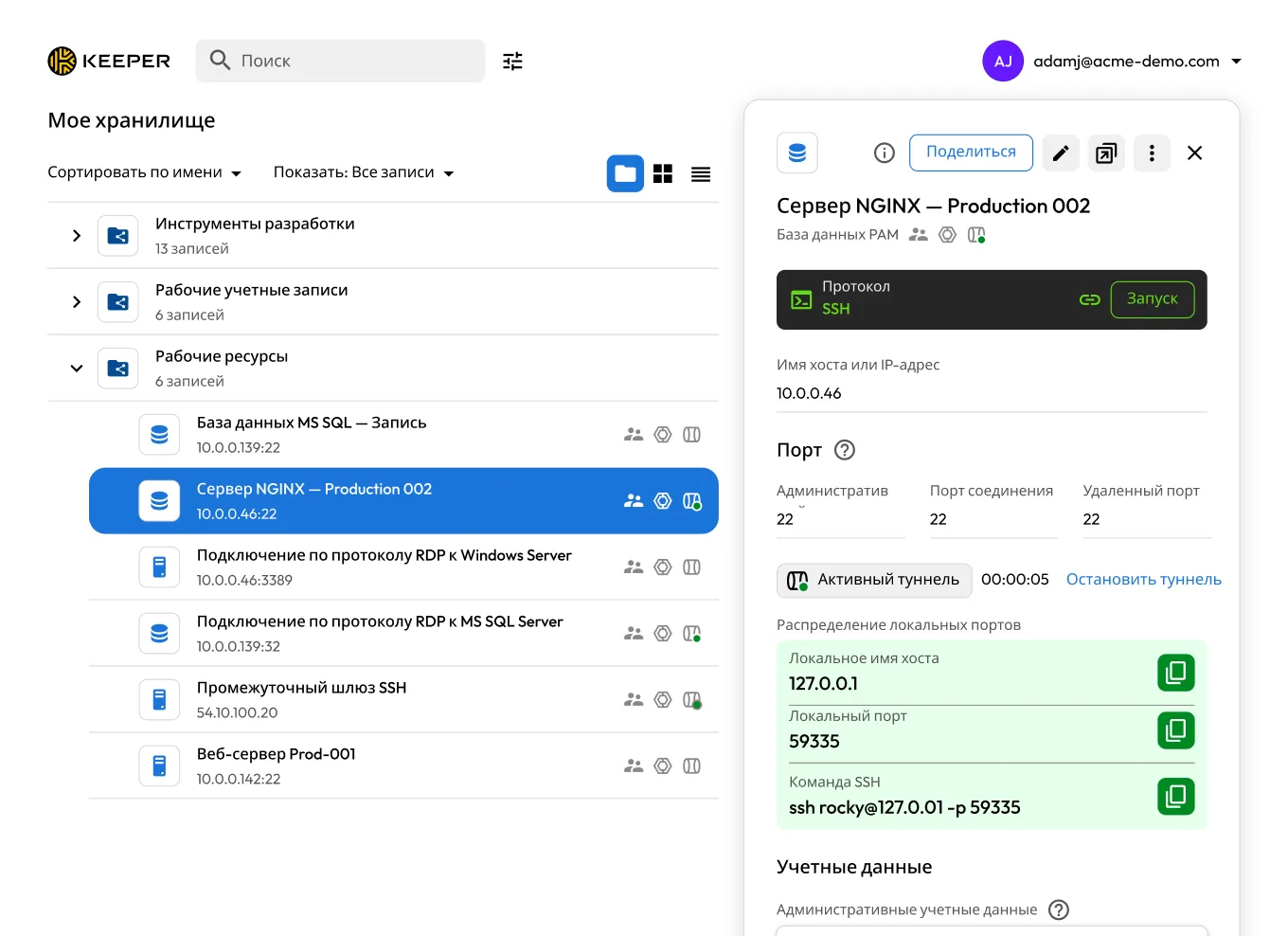
Keeper provides agentless privileged session management across SSH, RDP, VNC, database sessions and remote browser sessions, all from the Keeper Vault with no software installed on target systems.
Every session is end-to-end encrypted with unique per-session keys, stored in the customer-managed vault, and can only be decrypted by authorized users. Administrators can search session content, review keystroke logs and replay recordings from the vault.
KeeperAI monitors active sessions in real time, classifies behavior by risk level and can automatically terminate sessions when threats are detected, without human intervention.
Based on publicly available documentation, One Identity Safeguard for Privileged Sessions provides strong session recording, full-text indexing and OCR search.
Safeguard for Privileged Analytics adds user behavior analytics, running 13 machine learning algorithms against session data, as well as anomaly detection and risk-ranked alerting.
These analytics run on the Safeguard appliance, which centrally processes session data, whereas Keeper's zero-knowledge model ensures session recordings remain encrypted and inaccessible to the platform itself.
SSO integration and identity provider flexibility
Keeper SSO Connect® integrates with any SAML 2.0-compliant IdP, including Microsoft Entra ID, Okta, Google Workspace, AWS, Duo, Ping, OneLogin and JumpCloud, without requiring hardware, on-premises components or switching identity providers.
Keeper also extends SSO coverage to applications that don't natively support SAML, maintaining full zero-knowledge encryption throughout. SCIM provisioning handles real-time user provisioning, team assignment and deprovisioning automatically.
Based on publicly available documentation, One Identity supports SSO via SAML 2.0 and integrates with major IdPs, including Microsoft Entra ID, Okta and AD FS. However, One Identity's broader ecosystem, including Active Directory integration through Safeguard Authentication Services, identity governance through One Identity Manager and sudo management through Privilege Manager for Unix, creates dependencies on other One Identity products to extend certain functionality.
Organizations that want integrations beyond the core PAM capabilities may find themselves adopting a broader One Identity product stack, introducing additional procurement, licensing and deployment considerations.
Secure database access
Keeper provides KeeperDB, a built-in database management interface inside the Keeper Vault and available as a standalone desktop app as well. Privileged users can securely query and manage MySQL, PostgreSQL and Microsoft SQL Server databases without credentials ever touching a local device.
Every session runs inside Keeper Remote Browser Isolation, is fully recorded and is governed by centralized least-privilege policies with a complete audit trail. Administrators can enforce read-only sessions, grant time-limited access and control data exports, all from the same console that manages every other aspect of the platform.
One Identity supports database account credential management and session proxying for database access through its Safeguard for Privileged Passwords and Safeguard for Privileged Sessions products.
One Identity does not offer a native browser-based database management interface with KeeperDB's zero-credential-exposure model, in which the database connection is fully brokered within the vault, with credentials never reaching local endpoints. Database sessions through Safeguard are proxied and recorded, but database management and querying are handled through local client tooling.